Meet Plumsense at IAAPA Expo 2026 · Booth W2282 · Orlando, FL · Nov 17–20, 2026
 Visit us at www.plumsense.com


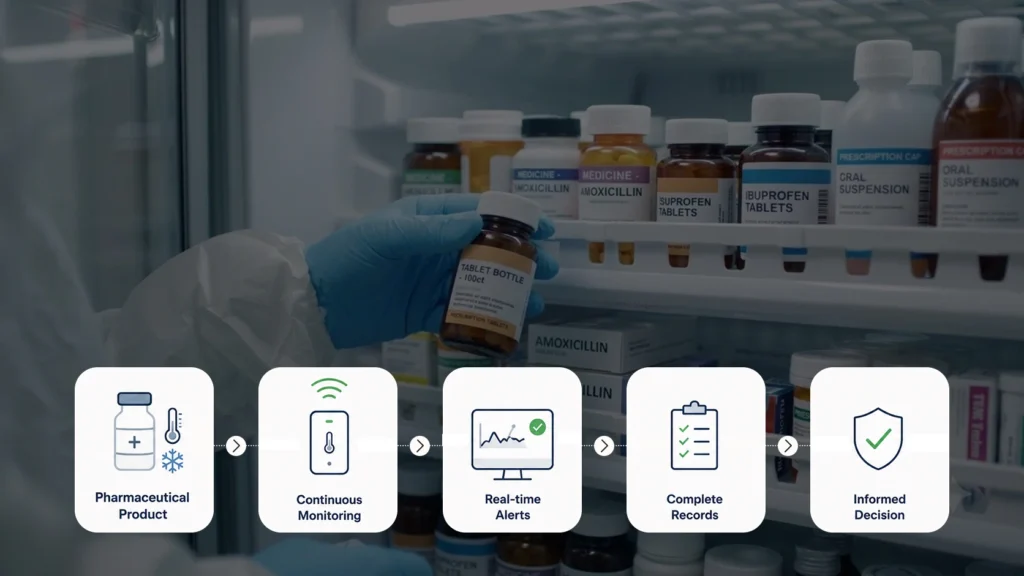
Temperature-sensitive medicines must stay within approved temperature limits during storage, transport, and delivery. A reliable pharmaceutical cold chain monitoring process helps teams track these conditions throughout the supply chain. When a product moves outside those limits, it is called a temperature excursion. This can happen in a warehouse, refrigerator, delivery vehicle, airport, loading area, pharmacy, or hospital.
A temperature excursion does not always mean that a medicine is unsafe or unusable. However, it must be recorded, reviewed, and handled in accordance with the company’s quality process. Pharmaceutical teams need to understand how FDA requirements and EU GDP expectations apply to temperature excursions, what records should be reviewed, and when an excursion may lead to a recall.
What Is a Pharmaceutical Cold Chain Temperature Excursion?
A pharmaceutical cold chain temperature excursion happens when a medicine is exposed to a temperature outside its approved storage or transport range. For example, a product labelled for storage between 2°C and 8°C may be exposed to higher or lower temperatures during a shipment delay or equipment failure.
The temperature reading alone does not show the full level of risk. The quality team should also review:
- How far the temperature moved outside the approved range
- How long the exposure lasted
- Whether the product was exposed to heat, freezing, or repeated changes
- The product’s stability data
- The calibration status of the monitoring device
Different medicines can react differently to the same conditions. Stability data show how product quality may change over time, while regular temperature sensor calibration supports accurate monitoring records.
Common Causes of Cold Chain Temperature Excursions
Temperature excursions can happen at any stage of the pharmaceutical supply chain. Common causes include equipment failure, power loss, poor packaging, shipment delays, open refrigerator doors, incorrect sensor placement, and slow responses to alarms.
Staff may also set the wrong temperature limit, place a sensor incorrectly, miss an alarm, or fail to follow the loading process. A strong cold chain plan should cover both equipment and staff responsibilities.
FDA Guidance for Pharmaceutical Storage and Temperature Control
FDA’s current good manufacturing practice (CGMP) requirements state that written warehousing procedures must be established and followed. Drug products must be stored under suitable temperature, humidity, and light conditions so that their identity, strength, quality, and purity are not affected. They must also be quarantined before release by the quality control unit.
FDA does not require every pharmaceutical business to use the same sensor, software platform, or alert method. The monitoring approach should match the product, storage area, transport process, and level of risk.
A company should keep clear temperature records, calibration records, alarm history, written procedures, deviation reports, corrective actions, and product release decisions. Properly selected temperature and humidity data loggers can support continuous monitoring and digital records. These records help explain what happened and how the event was handled.
A product should not be released only because it looks normal. Changes in quality may not be visible, so the decision should be based on reliable data and the approved quality process.
EU GDP and EMA-Related Expectations
In Europe, Good Distribution Practice sets minimum standards for protecting the quality and integrity of medicines throughout the supply chain.
The EU GDP guidelines cover storage conditions, temperature mapping, monitoring equipment, calibration, alarms, transport controls, and the investigation of temperature deviations. They also state that temperature-sensitive products should be transported using suitable equipment and that approved conditions should be maintained during transport.
EMA provides GMP and GDP questions and answers that offer additional interpretation of EU requirements, while the main EU GDP guidelines are published by the European Commission.
Does Every Temperature Excursion Lead to a Recall?
No. A temperature excursion does not automatically require a recall. The first steps are usually to place the affected product on hold, prevent further use or distribution, and begin an investigation.
The final decision depends on the temperature reached, exposure time, product type, available stability data, batch status, and whether the product has already entered the market.
A recall may be considered when the company cannot confirm that the product still meets its quality requirements or when there may be a risk to patients. FDA defines a drug recall as an action taken by a company to remove a product from the market. A recall may begin through the company’s own action, an FDA request, or an FDA order under legal authority.
The situation is more complex when affected products have already been sent to pharmacies, hospitals, clinics, or patients. Fast access to shipment and temperature records can support a quicker decision.
What to Do After a Temperature Excursion
Every company should have a written response process. The exact steps may vary, but a practical investigation usually includes:
- Identify the affected product, batch, shipment, and location.
- Place the product on hold or move it to a quarantine area.
- Secure the original temperature records.
- Confirm the sensor ID and calibration status.
- Record the highest and lowest temperatures and total exposure time.
- Review the approved storage range and available stability data.
- Check equipment logs, packaging, and transport records.
- Identify the likely root cause.
- Decide whether the product can be released, returned, rejected, or recalled.
- Record corrective and preventive actions.
The quality unit should approve the final product decision. Other teams may provide information, but the decision should be based on documented evidence.
How to Investigate the Root Cause
A good investigation should explain what happened, why it happened, and what will change to prevent the same issue.
Start by creating a timeline. Record when the excursion began, when the alert was sent, when someone responded, and when the product was placed on hold. Compare the temperature data with delivery records, equipment logs, power events, and route changes.
The investigation should also check whether the alert process worked. A refrigerator may have failed, but the larger problem may be that the alert went to an inactive phone number. A shipment may also remain in an uncontrolled area longer than expected.
Corrective actions may include staff training, a backup contact list, improved packaging, better sensor placement, alarm testing, equipment repair, or transport route changes.
How Better Monitoring Can Reduce Recall Risk
A real-time cold chain monitoring case study can also show how continuous monitoring and alerts work in practical cold chain operations. Continuous records also make it easier to understand the full temperature history.
Plumsense helps pharmaceutical teams monitor storage areas, refrigerators, freezers, and shipments while keeping digital records for review. Alerts can help the right people respond when conditions move outside the set limits.
Sensor placement is also important. A sensor placed beside a cooling vent may not show the actual temperature around the product. Temperature mapping can identify hot and cold areas and support better sensor placement. EU GDP guidelines call for initial temperature mapping under representative conditions before storage areas are used.
With Plumsense, teams can improve visibility across storage and transport points. However, technology should support a clear quality process. Companies still need approved limits, response procedures, trained staff, escalation steps, and regular record reviews.
Final Thoughts
Pharmaceutical cold chain temperature excursions cannot always be prevented, but their impact can be controlled. A fast response, reliable monitoring data, clear procedures, and a careful quality review can help reduce product loss and protect patient safety.
FDA requirements focus on written warehousing procedures and suitable storage conditions. EU GDP guidance also covers monitoring, temperature mapping, calibration, alarms, and transport controls throughout storage and distribution.
A temperature excursion does not automatically lead to a recall. The final decision should be based on product stability data, exposure conditions, the stage of distribution, and the possible risk to product quality.
Reliable monitoring systems such as Plumsense can help teams maintain clearer temperature records and respond more quickly when conditions move outside approved limits. Combined with trained staff and a well-defined quality process, this can support faster investigations and better-informed product decisions.
Frequently Asked Questions
These updates target the valuable queries naturally:
- Temperature excursion meaning
- Temperature excursion guidelines FDA
- FDA recall notices temperature control cold chain
- Temperature excursion alert software
- How to prevent temperature excursions
Do not use the full long-tail queries word-for-word repeatedly. The optimized sections cover their meaning naturally without keyword stuffing.