Meet Plumsense at IAAPA Expo 2026 · Booth W2282 · Orlando, FL · Nov 17–20, 2026
 Visit us at www.plumsense.com


If you’re managing a pharmacy, warehouse, lab, or any facility that stores temperature-sensitive products, you know one mistake can be expensive. One temperature spike. One humidity shift. That’s all it takes to lose thousands of dollars’ worth of inventory.
The problem is simple: manual temperature checks don’t work. You can’t be everywhere at once. That’s why temperature and humidity data loggers have become essential. They work 24/7, automatically keep records, and alert you instantly when something goes wrong.
I’ll show you how to choose the right data logger for your specific needs.
Which Wireless Data Logger Is Best for GMP Monitoring?
For GMP monitoring, choose a wireless data logger that can record temperature and humidity properly, send alerts when conditions change, and provide reports for review. The right choice depends on your storage area, network setup, and compliance needs.
For medical, pharmacy, and lab storage, a logger with strong reporting and calibration records is useful. For large warehouses, long-range wireless monitoring can help cover more areas without manual checks. For small storage rooms or temporary monitoring, a simple wireless logger may be enough.
The main goal is to keep clear records, reduce manual work, and respond quickly when temperature or humidity goes outside the safe range.
Which Data Logger Is Best for Your Facility?
For GMP audits requiring FDA 21 CFR Part 11 compliance: → TempTag™ FX200 — CDC-compliant, NIST-traceable ±0.5°C accuracy, full audit trail documentation
For large facilities with multiple temperature zones: → TempTag™ D200 — Long-range LoRaWAN covers entire buildings, compliance-suitable monitoring
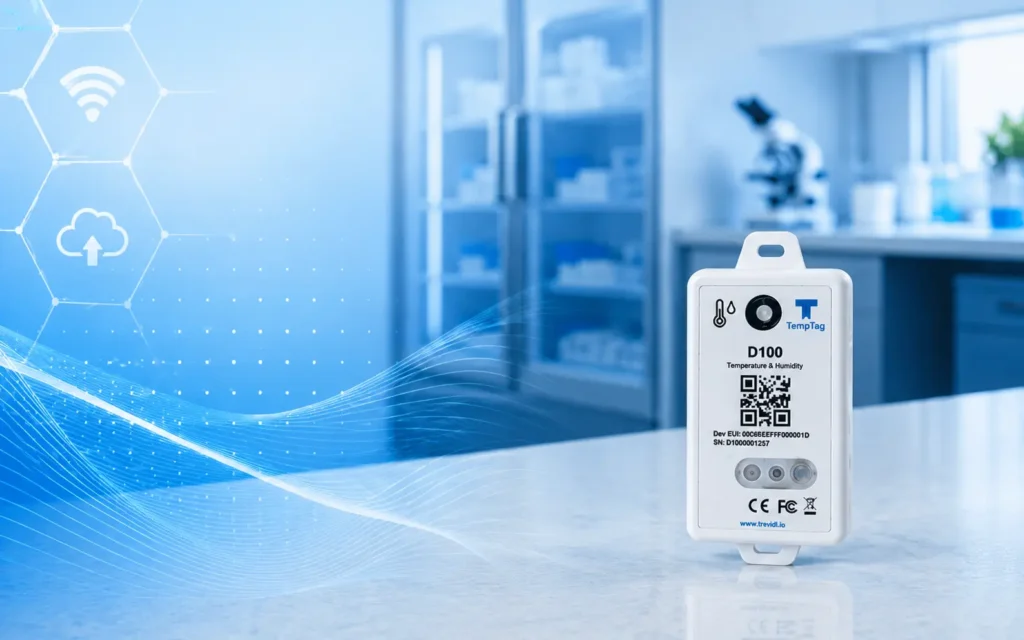
For medium facilities with IoT requirements: → TempTag™ D100 — Built-in sensor, easier deployment, compliance-suitable, integrates with IoT
For temporary monitoring or small storage areas: → TempTag™ FX700 — Affordable, mobile-ready, quick setup, Bluetooth to your phone
What is a Temperature and Humidity Data Logger?
A data logger continuously monitors and records temperature and humidity levels. It watches your environment, records the data, and stores it so you have proof of what happened.
Here’s why it matters:
- It works all the time: Your logger records data every few minutes or every hour, even while you’re focused on other tasks
- You have documentation: Inspectors see exact records showing the temperature at every moment
- You get alerts immediately: Notifications alert you if the temperature goes out of range, so you can fix problems in minutes instead of discovering them the next day
For businesses handling vaccines, medications, food, and electronics, a data logger is necessary. Many organizations choose Plumsense data loggers because they combine reliability with ease of use.
Types of Data Loggers Available
Long-Range Wireless Data Loggers
The TempTag™ D200 uses the LoRaWAN protocol for long-range data transmission. It’s ideal for large facilities that need to monitor multiple areas across walk-in coolers, warehouse zones, or multiple storage areas.
Benefits:
- Covers large areas without running cables
- Works through walls and obstacles
- Multiple devices communicate with one central system
- Battery lasts 6-12 months
- Real-time monitoring from the dashboard
The TempTag™ D100 also uses LoRaWAN and includes a built-in temperature and humidity sensor for faster, easier setup.
Bluetooth Data Loggers
The TempTag™ FX700 connects directly to your mobile device via Bluetooth Low Energy (BLE). It’s compact, portable, and simple to use.
Good for:
- Small to medium facilities
- Quick checks on your phone
- Locations without WiFi
- Temporary monitoring projects
- Single storage areas
Clinical-Grade Data Loggers
The TempTag™ FX200 is designed specifically for healthcare facilities and pharmaceutical storage. It measures both temperature and humidity and meets CDC guidelines for clinical environments.
Features:
- CDC compliance documentation
- Precise humidity monitoring (±2% RH)
- Wireless transmission
- Automatic alerts for out-of-range conditions
- Records suitable for regulatory inspections
For facilities that need pharmaceutical GMP compliance, consider pairing the FX200 with our IQ OQ PQ Validation Service to guarantee compliance at every step.
Comparison Chart: TempTag Models for GMP Compliance
| Feature | TempTag D200 | TempTag D100 | TempTag FX200 | TempTag FX700 |
| Best For | Large warehouses | Medium facilities, IoT | Pharmacies, clinical | Small/temporary |
| Temperature Accuracy | ±0.5°C NIST | ±0.5°C NIST | ±0.5°C pharma-grade | ±1.0°C |
| Humidity Monitoring | Yes | Yes | Yes (precise) | No |
| Communication | LoRaWAN long-range | LoRaWAN standard | WiFi + Bluetooth | Bluetooth |
| Range | 2+ miles | 1 mile | 100 feet | 100 feet |
| GMP Compliance | Suitable | Suitable | Full FDA 21 CFR Part 11 | Limited |
| NIST Calibration | Yes | Yes | Yes | No |
| Battery Life | 6-12 months | 6-12 months | 6-12 months | 3-6 months |
| Real-time Alerts | Yes | Yes | Yes | Yes |
| Audit Trails | Automated | Automated | Full logging | Basic |
| Price Range | $400–500 | $300–400 | $600–700 | $150–200 |
Quick model summary:
- TempTag D200 is useful for large warehouses and long-range monitoring.
- TempTag D100 is a good option for medium facilities that need IoT-based monitoring.
- TempTag FX200 is suitable for pharmacies, healthcare, and medical storage where alerts and records are important.
- TempTag FX700 is useful for small storage areas or simple Bluetooth-based monitoring.
GMP & FDA Compliance Features to Review
When FDA or GMP auditors visit your facility, they look for five critical things:
1. NIST-Traceable Calibration
Your temperature readings must be verified against national standards. NIST (National Institute of Standards & Technology) is the U.S. government’s official measurement standard. All TempTag models include NIST-traceable certificates proving accuracy within ±0.5°C or ±1.0°C.
Why it matters: When auditors ask, “How do you know your readings are accurate?” your NIST certificate is your proof.
2. 21 CFR Part 11 Compliance (Electronic Records)
FDA regulation 21 CFR Part 11 requires tamper-proof electronic records showing:
- When each temperature reading was taken
- Who accessed the data
- That data wasn’t altered
The TempTag™ FX200 provides full compliance. The D200 and D100 are suitable for most commercial applications.
3. Automated Audit Trails
Every action must be automatically logged:
- Who logged in to view data
- When they accessed it
- What alerts were triggered
Example: When temperature spikes, your audit trail automatically shows:
- 14:32 — Alert triggered (+5°C above limit)
- 14:32:03 — SMS sent to manager
- 14:35 — Manager responded
- Response time: 3 minutes (documented automatically)
4. Encrypted Data Storage
Temperature data must be protected:
- AES-256 encryption (military-grade)
- HIPAA/GDPR-compliant servers
- Automatic backups every 6 hours
5. Real-time Alerts & Documentation
When the temperature goes out of range, your system immediately:
- Sends instant notification (SMS/email/app)
- Creates an incident log with a timestamp
- Allows you to document your response
Compliance Checklist for Your Facility
- Are sensors calibrated to NIST standards?
- Does your system create tamper-proof electronic records? (21 CFR Part 11)
- Are audit trails automated?
- Is data encrypted in transit and at rest?
- Do you get real-time alerts?
- Can you automatically generate compliance reports?
- Is data backed up automatically?
If you answered NO to any of these, your facility is not GMP-compliant.
Industry Standards Supported by TempTag Data Loggers
| Standard | TempTag Compliance |
| FDA 21 CFR Part 11 | FX200 = Full; D200/D100 = Suitable |
| CDC Guidelines | All suitable; FX200 = Full |
| EU Annex 11 | FX200 = Full compliance |
| NIST SP 800-171 | All models compliant |
| ISO/IEC 17025 | All models supported |
| HIPAA | All models HIPAA-ready |
| GDPR | All models GDPR-compliant |
Key Features to Compare Before Buying
When selecting a data logger, focus on these factors:
Accuracy – ±0.5°C is pharmaceutical-grade. ±1.0°C works for food and general storage. ±2.0°C is basic monitoring.
Range and Coverage – Long-range loggers like TempTag™ D200 work across entire facilities. Bluetooth loggers like TempTag™ FX700 work within your building.
Sensor Quality – All TempTag models measure both temperature and humidity accurately, engineered to meet strict performance specifications.
Battery Life – You want at least 6-12 months minimum. Plumsense data loggers are designed for extended operation between battery maintenance.
Data Storage – Cloud backup is better than local storage only.
Alerts – Real-time alerts give you time to respond to problems before they become expensive.
Compliance – TempTag™ FX200 meets CDC guidelines and full FDA compliance. TempTag™ D200 and TempTag™ D100 are suitable for general commercial use and made in the US.
Choosing the Right Data Logger for Your Situation
For Medical Storage, Pharmacies, and Healthcare Facilities
You need high accuracy and compliance documentation. Patient safety depends on proper storage conditions.
Medical storage areas require consistent temperature records because vaccines, medicines, samples, and other sensitive items can be affected by temperature fluctuations. A wireless data logger helps staff monitor storage conditions and receive alerts when readings move outside the safe range.
For medical storage, choose a logger that supports accurate records, calibration documentation, alert history, and easy reporting. This can help clinics, pharmacies, labs, and healthcare teams manage daily monitoring with less manual work.
Best choice: TempTag™ FX200 Wireless Data Logger
- Designed for clinical environments
- Meets CDC guidelines
- Includes humidity monitoring
- Provides compliance-ready documentation
- Wireless transmission (no cables)
Wireless Data Loggers for Warehouses and Large Facilities
Warehouses often have many storage zones, cold rooms, freezers, loading areas, and high-risk spaces. A wireless data logger helps teams monitor temperature and humidity without checking every area manually.
For warehouse monitoring, look for long-range wireless coverage, real-time alerts, battery backup, and simple reporting. These features help teams respond faster when storage conditions change.
| Requirement | Why It Helps |
|---|---|
| Long-range wireless monitoring | Useful for large warehouses and multi-zone storage |
| Temperature and humidity alerts | Helps teams respond when readings move outside the set range |
| Cloud reports | Makes it easier to check monitoring history |
| Calibration support | Helps maintain accurate records |
| Multiple sensor support | Useful for different rooms, cold areas, and storage zones |
For warehouses, the best data logger is the one that gives reliable coverage, clear alerts, and easy reports for daily review.
For Medium Facilities with IoT Integration
You want a modern system that integrates with building management.
Best choice: TempTag™ D100
- LoRaWAN protocol for modern facilities
- Built-in temperature and humidity sensor
- Integrates with existing IoT systems
- Long battery life
- Easy deployment
How to Choose a Temperature and Humidity Data Logger Step by Step
Step 1: Identify what you’re protecting. What products are temperature-sensitive? How much are they worth?
Step 2: Know your environment. How large is your facility? Do you have multiple storage areas?
Step 3: Check your requirements. Do you need compliance documentation? What standards apply to your industry?
Step 4: Compare your options:
- Large facility with multiple zones? → TempTag™ D200
- Clinical/pharmaceutical? → TempTag™ FX200
- Small operation or mobile use? → TempTag™ FX700
- Modern IoT system? → TempTag™ D100
Step 5: Calculate your ROI. The cost of a data logger is small compared to preventing one loss. Even one prevented incident pays for the equipment many times over.
Common Mistakes to Avoid When Choosing a Data Logger
Don’t choose based on price alone. The cheapest logger might fail exactly when you need it most. Invest in quality.
Don’t ignore accuracy specifications. If you need ±0.5°C but buy ±2.0°C equipment, you won’t actually protect your products.
Don’t skip alerts and notifications. A logger that only stores data without alerting you is less useful than one that notifies you immediately.
Don’t overlook compliance needs. If your industry requires specific documentation, make sure your logger provides it. The TempTag™ FX200 is built for clinical compliance.
Don’t delay implementation. Every day without monitoring is a day your inventory is at risk.
Data Loggers for Food Safety Monitoring
Food storage areas such as walk-in coolers, freezers, prep areas, and cold rooms need regular temperature checks. A wireless data logger can help food service teams record temperatures, reduce manual logs, and respond faster when storage conditions change.
For food safety monitoring, choose a logger that provides clear temperature history, alerts, and reports. This is useful for restaurants, grocery stores, convenience stores, commercial kitchens, and cold storage areas.
Final Thoughts
Choosing the right data logger means protecting your business. Whether you use the TempTag™ D200 for a large warehouse, the TempTag™ FX200 for a pharmacy, the TempTag™ FX700 for mobile monitoring, or the TempTag™ D100 for a modern IoT system, the right choice depends on your specific needs.
Don’t let temperature and humidity changes damage your products or business. Get the monitoring in place today.
Contact us today for more information about finding the right Plumsense solution for your facility. Our team can help you assess your specific requirements and recommend the best data logger for your situation.