When you’re responsible for storing temperature-sensitive products, you face a critical decision: should you use data loggers or wireless temperature sensors? This choice affects your safety, compliance, and budget. Let’s break down both options so you can pick what works best for your situation.
What Are Data Loggers?
Data loggers are small devices that record temperature readings over time. They store this data in their internal memory and don’t send information anywhere in real-time. You install them where you need to monitor temperature, and they work independently until you download the data later.
Here’s how they work: A data logger sits in your refrigerator, freezer, or storage area. It measures the temperature every few minutes and saves each reading. After days or weeks, you connect the device to a computer and download all the recorded data. You can then review the temperature history to confirm it stayed within safe limits.
Plumsense offers data loggers like the TempTag™ D100, which uses LoRaWAN technology. The TempTag™ D100 Temperature & Humidity Data Logger gives you accurate readings and can work with external probes when you need more flexibility in your monitoring setup.
Advantages of Data Loggers
- Lower upfront cost – Data loggers are typically cheaper than wireless systems, making them a good choice if you have a limited budget.
- No network needed – They don’t require WiFi or cellular connection. You can use them anywhere without setting up infrastructure.
- Long battery life – Many data loggers last for months on a single battery charge because they’re not constantly transmitting data.
- Simple to use – There’s no complicated software to learn. Plug it in, let it record, and download the data when you need it.
- Good for short-term monitoring – If you’re tracking temperature during delivery or for a specific shipment, data loggers work well.
Disadvantages of Data Loggers
- No real-time alerts – You won’t know there’s a problem until you download and check the data. By then, your products might be damaged.
- Manual data management – You have to remember to download the data regularly. If you forget, you might lose recent readings.
- Limited visibility – You can’t check on your storage area unless you’re physically present with the device.
- Time-consuming documentation – Especially with multiple locations, managing data from different loggers becomes tedious for compliance records.
- No immediate action on problems – If the temperature goes wrong, you discover it after the fact, not when it happens.
What Are Wireless Temperature Sensors?
Wireless temperature sensors are devices that measure temperature and send the data to a cloud system in real-time. They connect using WiFi, Bluetooth, or other wireless technologies. You monitor everything from your phone or computer, anytime and anywhere.
Wireless sensors work constantly. They check the temperature every few minutes and automatically send updates to your Plumsense cloud dashboard. If something goes wrong, you get an instant alert through text, email, or app notification.
Plumsense offers several wireless options. The TempTag™ FX700 BLE Data Logger uses Bluetooth Low Energy to connect with your gateway or mobile device. You can see live temperature readings in the Plumsense app and get instant alerts if conditions change. For larger operations, the M500 Gateway IoT acts as the bridge between your sensors and the cloud, supporting multiple communication protocols and ensuring seamless connectivity.
Advantages of Wireless Sensors
- Real-time monitoring – You see what’s happening right now, not days later. Monitor your freezers from your office or home.
- Instant alerts – Get immediate notification if the temperature goes out of range. You can take action before products spoil.
- No manual data entry – Everything is automatically recorded and stored in the cloud. No downloading, no organizing files.
- Works across multiple locations – Monitor 5 freezers, 10 locations, or 100 storage areas from one dashboard. This is huge for large operations.
- Audit-ready reports – When inspectors come, you have all the data ready. The system generates compliance reports automatically.
- Better staff accountability – Clear records show exactly what happened and when. This matters for food safety and healthcare compliance.
- Predictive maintenance – Watch for temperature patterns that suggest equipment is failing. Fix it before it breaks down.
Disadvantages of Wireless Sensors
- Higher initial cost – The equipment, gateway, and software subscription add up. Especially if you need many sensors.
- Requires setup – You need a WiFi network or gateway installation. Might need IT help.
- Ongoing subscription – Monthly or yearly fees for cloud storage and a monitoring platform.
- Battery replacement – Wireless sensors still need batteries, though less frequently than data loggers. Battery life is usually 6-24 months, depending on the model.
- Potential connectivity issues – If your WiFi or gateway goes down, you lose real-time monitoring until it’s fixed (though most systems store data locally and sync when the connection returns).
Call NowRequest a Quote
Which Solution Works for Different Industries?
Healthcare Facilities
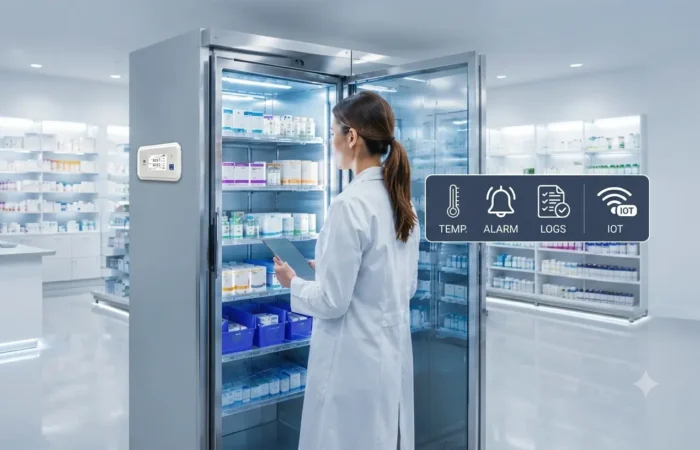
Hospitals, clinics, and pharmacies need wireless sensors. Why? They must monitor vaccine storage, blood banks, and medication refrigerators 24/7. Missing a temperature change for even a few hours could spoil life-saving products.
The Plumsense FX Series is designed specifically for healthcare. It provides the real-time alerts and automatic documentation that hospitals need to meet Joint Commission and CDC requirements.
Food Service Operations
Restaurants, cafeterias, and catering companies benefit from wireless sensors. A walk-in cooler failure can destroy thousands of dollars in food. With wireless monitoring, you get an alert the moment something goes wrong.
For cook-chill operations, the Plumsense system monitors critical temperatures throughout the cooking, cooling, and storage process automatically.
Pharmaceutical Storage
Medicines must stay within exact temperature ranges. The M500 Gateway IoT and associated sensors from Plumsense provide the precision and documentation that pharmaceutical facilities need.
Cold Chain Logistics
If you’re shipping products over long distances, wireless sensors give you visibility. You know the temperature conditions during transport, which matters for customer confidence and regulatory compliance.
Data loggers still work for shorter shipments where the budget is tight, but wireless sensors are becoming standard in the industry.
HACCP and Compliance
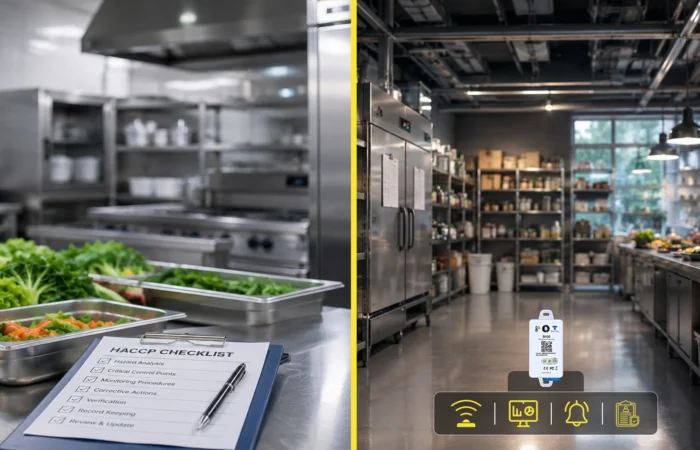
If you work in food service, you know about HACCP (Hazard Analysis and Critical Control Points). Good documentation is everything during inspections.
Data loggers give you raw data that you manually organize into compliance reports. It works, but it’s tedious and error-prone.
The Plumsense Dashboard automatically generates compliance-ready reports. When an inspector asks for documentation, you download it in seconds. This level of readiness matters.
Making Your Decision
Choose a data logger if:
- You’re on a tight budget
- You monitor for short periods (days or weeks)
- You have only one or two locations
- You don’t need real-time information
- Your operation is small and simple
Choose a wireless sensor if:
- You need 24/7 monitoring
- You manage multiple locations
- Compliance is critical to your business
- You want to prevent product loss
- Your facility is large or complex
The Plumsense Solution
Plumsense makes this decision easier by offering both options. If you need to start small with data loggers, we have the TempTag™ D100. As your business grows or your needs change, we offer wireless solutions like the TempTag™ FX700 and the M500 Gateway IoT.
Our Plumsense Dashboard works with all our sensors, giving you real-time visibility when you need it. Our Plumsense Mobile App lets you check temperatures from anywhere.
With Plumsense, you also get:
- Real-time temperature alerts via text, email, or app
- Automatic compliance reports for audits
- Monitoring across multiple locations from one place
- NIST-traceable calibration certificates
- Support from our team when you need it
Conclusion
Choosing between data loggers and wireless temperature sensors depends on your specific needs and budget. Data loggers work well for small operations with short-term monitoring needs and tight budgets. They’re simple, affordable, and require no setup.
Wireless sensors are the smart choice for healthcare facilities, restaurants, pharmacies, and any operation that needs 24/7 monitoring. They give you real-time alerts, automatic compliance reports, and the ability to prevent costly product losses.
The good news? Plumsense offers both solutions. Start with the TempTag™ D100 if you’re on a budget, then upgrade to wireless options like the TempTag™ FX700 BLE Data Logger as your business grows. Whatever you choose, our Plumsense Dashboard and Plumsense App make monitoring simple.
Your temperature-sensitive products deserve protection. Don’t wait for a failure to discover your monitoring system isn’t working. Take action today and choose the solution that keeps your products safe, your compliance documents ready, and your business protected.