Meet
us
at NACAS C3X 2026 · Booth 120 · Chicago · Sep 27–30, 2026
Meet
us
at NACAS C3X 2026 · Booth 120 · Chicago · Sep 27–30, 2026 See continuous monitoring live at Booth 120 · Book a 15-minute demo
 Visit
us at www.plumsense.com
Visit
us at www.plumsense.com

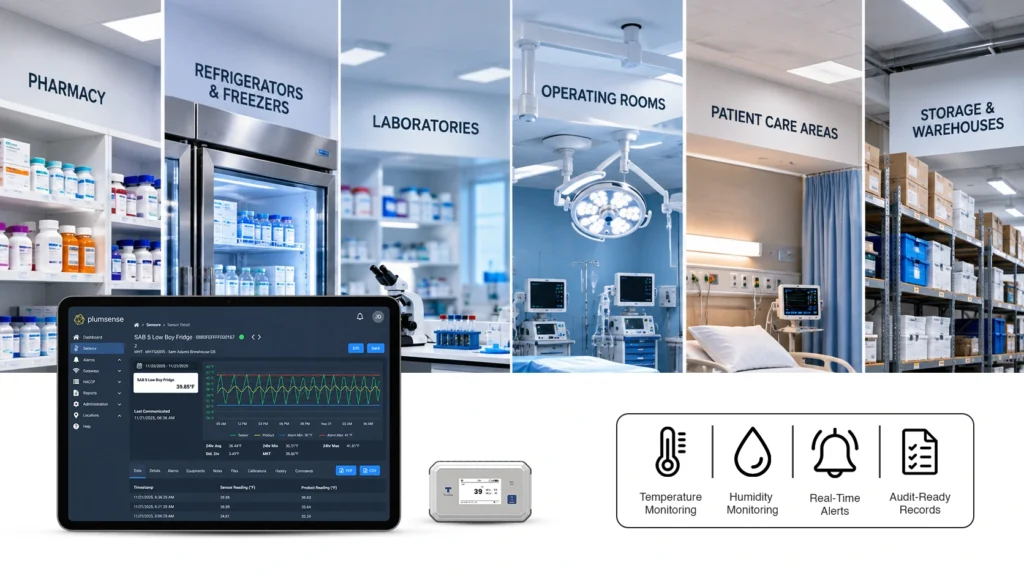
In a healthcare facility, environmental conditions are more than just numbers on a screen. A small change in temperature, humidity, or air pressure can affect medications, vaccines, laboratory materials, equipment, and even patient safety.
That’s why healthcare environmental monitoring plays an important role in maintaining safe and controlled conditions across hospitals, clinics, laboratories, pharmacies, and other healthcare facilities.
But effective monitoring involves more than simply recording temperature readings. Healthcare teams need to know which areas require monitoring, what conditions to track, when to trigger an alert, and how to maintain monitoring records for audits and quality checks.
This checklist walks you through the key areas to consider when setting up or strengthening an environmental monitoring program in a healthcare facility.
1. Identify the Areas That Need Environmental Monitoring
Before choosing sensors, setting alert limits, or implementing a monitoring system, start with one simple question:
Which areas in your facility need monitoring?
Different areas have different environmental requirements. Some locations may require temperature monitoring, while others may also need monitoring of humidity, air pressure, or other environmental parameters.
Depending on the facility and its operations, commonly monitored areas may include:
- Hospital refrigerators and freezers
- Vaccine storage areas
- Pharmacies
- Medication storage rooms
- Laboratories
- Operating rooms
- Patient care areas
- Blood and specimen storage areas
- Clean rooms
- Equipment storage rooms
- Warehouses
- Cold rooms
Start by creating a complete list of critical areas and documenting the environmental conditions to monitor in each.
For healthcare facilities managing multiple departments or locations, a centralized healthcare temperature monitoring system can make this process easier. Instead of checking conditions across separate systems or locations, teams can monitor environmental conditions from a single platform.
2. Define Acceptable Temperature Ranges
Once you know which areas need monitoring, the next step is to define what “safe” looks like for each location. There is no one-size-fits-all temperature range for a healthcare facility.
The correct range depends on what is being stored and the requirements of the product, equipment, or facility.
For instance, some medicines and vaccines may need controlled refrigeration, while other medical supplies may need room-temperature storage.
Healthcare teams should avoid using the same temperature limits for every location.
Instead, establish clear limits for each monitored area, including:
- Minimum acceptable temperature
- Maximum acceptable temperature
- Normal operating range
- Alert limits
- Escalation procedure
These limits should be based on product instructions, internal quality procedures, and applicable regulatory requirements.
3. Monitor Humidity Where Required
Temperature gets most of the attention in environmental monitoring, but humidity can be just as important in certain healthcare environments.
Changes in humidity can affect areas where medicines, equipment, laboratory materials, or sensitive supplies are stored.
High humidity may contribute to problems with packaging, materials, and equipment, while very low humidity may create challenges in certain controlled areas.
If humidity monitoring is required in a particular area, make sure your monitoring process includes:
- Clearly defined humidity limits
- Sensors installed in suitable locations
- Continuous data recording where required
- Alerts available for unusual conditions
- Clearly defined actions for staff when limits are exceeded
Monitoring temperature and humidity together can give healthcare teams a clearer view of environmental conditions.
4. Check Sensor Placement
Where you place a sensor can be just as important as the sensor itself. Even a good monitoring system may provide misleading readings if sensors are placed in the wrong location.
Install sensors where they can capture the conditions that matter.
Avoid placing sensors:
- Directly beside doors
- Near heating or cooling vents
- In direct sunlight
- Against cold refrigerator walls
- Too close to heat-generating equipment
For refrigerators and freezers, sensor placement should reflect the temperatures experienced by the stored products.
Larger rooms may require multiple sensors because conditions can vary between different areas of the same space.
5. Use Continuous Monitoring for Critical Areas
Manual temperature checks have their place, but they only tell you what is happening at the moment the reading is taken.
A temperature problem can happen between two manual checks and may not be noticed.
Continuous environmental monitoring helps close this gap by automatically recording measurements throughout the day and night. This makes it easier to identify temperature changes, equipment problems, or unusual conditions.
Plumsense provides monitoring solutions designed to help healthcare teams track environmental conditions and manage records without depending only on manual checks.
For hospitals managing multiple rooms, refrigerators, or storage areas, hospital temperature monitoring automation can further reduce repetitive monitoring work.
6. Set Up Real-Time Alerts
Recording data is useful, but healthcare teams also need to know when something goes wrong.
Real-time alerts turn monitoring data into an actionable response. They can help staff respond quickly when monitored conditions move outside the acceptable limits.
Alerts may be triggered by situations such as:
- Refrigerator temperature rising
- Freezer temperature becoming too warm
- Temperature dropping below the allowed range
- High humidity
- Sensor communication failure
- Power interruption
- Door left open for too long
But sending an alert is only the first step. Notifications need to reach the right person at the right time.
It is also important to decide what happens if the first person does not respond. A clear escalation process can help make sure important alerts are not missed.
7. Create an Alert Response Process
Receiving an alert is only the first step.
Healthcare facilities should have a clear, easy-to-follow response process that explains what staff should do after receiving an environmental monitoring alert.
A typical response process may include:
- Check the current reading.
- Confirm whether the issue is still active.
- Inspect the equipment or monitored area.
- Protect or relocate temperature-sensitive products if required.
- Notify the responsible person.
- Record the action taken.
- Investigate the cause if necessary.
This process should be established before an incident occurs, rather than being created in the middle of one.
A clear response plan can reduce confusion during temperature excursions or equipment failures.
8. Keep Accurate Environmental Monitoring Records
Environmental monitoring records may be needed for internal reviews, audits, inspections, and quality management.
Healthcare facilities should be able to review historical data when needed.
Depending on the facility’s requirements, records may include:
- Temperature readings
- Humidity readings
- Alert history
- Acknowledged alerts
- Corrective actions
- Sensor information
- Calibration records
- User activity
- Equipment maintenance records
Digital data logging can make these records easier to capture, organize, review, and retrieve than scattered manual logs.
With centralized monitoring data and alerts, Plumsense can help healthcare teams streamline record-keeping while maintaining greater visibility into environmental conditions across monitored areas.
9. Check Sensor Calibration
Monitoring data is only useful when sensors are working correctly. Even a reliable monitoring system cannot provide meaningful information if its sensors are not measuring conditions correctly.
Healthcare facilities should have a process for checking and maintaining their monitoring devices.
Calibration schedules may depend on internal policies, equipment type, manufacturer guidance, and regulatory expectations.
Maintain records of:
- Calibration date
- Calibration result
- Sensor identification
- Next calibration date
- Corrective action if a device fails calibration
It is also helpful to track sensors that are replaced, moved, or removed from service. Keeping this information organized helps teams understand the history of each monitoring device and supports better traceability during audits or investigations.
10. Review Backup and Connectivity Plans
What happens to your monitoring system when the network goes down? Wireless and cloud-based monitoring systems depend on communication between sensors, gateways, networks, and monitoring platforms.
Healthcare facilities should consider what happens if connectivity is temporarily lost.
When evaluating a monitoring system, check whether it can:
- Store readings during a network outage
- Send stored data after connectivity returns
- Identify and report sensor communication failures
- Alert users about device or battery issues
- Continue local monitoring when possible
Facilities should also have a backup response plan for major power or network failures.
11. Review Environmental Monitoring Reports Regularly
Do not wait for an audit or an equipment failure before reviewing monitoring data.
Regular reports can help teams identify repeated problems.
For example, reports may reveal that:
- A refrigerator frequently approaches its upper temperature limit
- A storage room becomes warmer at specific times of the day
- Frequent door openings are causing repeated temperature fluctuations
- A sensor regularly loses communication
- Certain locations generate more alerts than others
These patterns can help healthcare teams take action before a larger problem occurs.
12. Train Staff on the Monitoring System
Technology alone cannot manage environmental conditions. The best monitoring technology still depends on people who know how to use it.
Staff should understand how the monitoring system works and what they are responsible for.
Training should cover:
- How to check current readings
- How to respond to alerts
- Who should receive notifications
- How to document corrective actions
- How to review reports
- How to report sensor or equipment problems
Training should not be a one-time activity. Refresher training should be provided whenever monitoring procedures, responsibilities, equipment, or systems change.
Final Thoughts
Effective clinical environment monitoring is about more than collecting temperature and humidity readings. It is about knowing when conditions change, responding before a small issue becomes a larger problem, and having reliable records to support quality and compliance.
Healthcare facilities should regularly review their monitored locations, alert limits, sensor placement, calibration schedules, and response procedures.
For healthcare organizations looking to reduce reliance on manual checks and gain greater visibility across multiple locations, Plumsense offers real-time environmental monitoring solutions with continuous monitoring, alerts, centralized dashboards, and digital records. These capabilities can help teams monitor critical conditions, respond to deviations, and maintain more organized, audit-ready documentation.