IQ, OQ, and PQ are three stages of equipment qualification used in pharmaceutical, healthcare, and GMP-regulated facilities. Installation Qualification confirms that the equipment is installed correctly. Operational Qualification verifies that it operates within approved limits. Performance Qualification confirms that it performs consistently under normal working conditions.
Together, these stages provide documented evidence that the equipment is suitable for its intended use. They also support GMP compliance, equipment reliability, product quality, and audit readiness.
Plumsense supports pharmaceutical and healthcare organizations with qualification protocols, testing support, and audit-ready documentation.
What Is IQ OQ PQ Validation?
IQ OQ PQ validation is a step-by-step process used to qualify equipment, instruments, systems, and utilities. It is commonly used in pharma, healthcare, biotechnology, medical device, and GMP facilities. FDA guidance emphasizes that equipment qualification should confirm proper installation, operation within expected ranges, and suitability for its intended use.
IQ OQ PQ includes three main stages:
- IQ – Installation Qualification
- OQ – Operational Qualification
- PQ – Performance Qualification
Each stage has a different purpose. Together, they help confirm that equipment is suitable for its intended use.
For example, if a pharma company installs a new stability chamber, autoclave, HVAC system, laboratory instrument, or filling machine, it should be checked before routine use. IQ OQ PQ validation helps confirm that the equipment is installed correctly, operates properly, and performs consistently.
DQ, IQ, OQ, and PQ: Complete Qualification Sequence
Equipment qualification may begin with Design Qualification before moving to IQ, OQ, and PQ. Each stage confirms a different part of the equipment lifecycle.
The common qualification sequence is:
DQ → IQ → OQ → PQ
| Qualification stage | Full form | Main purpose |
|---|
| DQ | Design Qualification | Confirms that the proposed design meets user and process requirements |
| IQ | Installation Qualification | Confirms that equipment is installed and documented correctly |
| OQ | Operational Qualification | Confirms that equipment operates within defined limits |
| PQ | Performance Qualification | Confirms consistent performance under normal working conditions |
Why IQ OQ PQ Validation Matters in Pharma and Healthcare
Pharma and healthcare companies must follow strict quality and compliance requirements. Equipment used in manufacturing, testing, storage, and packaging must be reliable. If equipment does not work properly, it can affect product quality, patient safety, and regulatory compliance.
IQ OQ PQ validation helps companies in several ways.
First, it supports GMP compliance. GMP expects companies to use qualified equipment and controlled processes. IQ OQ PQ documents show that the equipment has been tested and approved before use.
Second, it improves product quality. Qualified equipment helps reduce variation and supports consistent output.
Third, it helps during audits and inspections. Auditors may ask for validation protocols, qualification reports, calibration records, deviation reports, and approval documents. A complete IQ OQ PQ file helps answer these questions clearly.
Fourth, it reduces the risk of equipment failure. Qualification helps identify problems before the equipment is used in routine production or healthcare operations.
Difference Between IQ, OQ, and PQ in Pharma
The main difference between IQ, OQ and PQ is the part of equipment qualification being tested. IQ checks installation, OQ checks operation and PQ checks performance during normal use.
| Qualification Stage | Full Form | Main Purpose | Simple Question It Answers |
|---|
| IQ | Installation Qualification | Checks whether the equipment is installed correctly | Is the equipment installed properly? |
| OQ | Operational Qualification | Checks whether equipment operates within approved limits | Does the equipment work correctly? |
| PQ | Performance Qualification | Checks whether the equipment performs consistently in real use | Does the equipment perform properly during actual use? |
All three steps are connected. IQ confirms installation, OQ confirms operation, and PQ confirms performance. Together, they support equipment qualification and GMP compliance.
What Is IQ in Pharma and Healthcare Validation?
IQ stands for Installation Qualification.
This is the first step in the validation process. IQ checks whether the equipment or system has been installed according to the approved requirements, manufacturer instructions, and site specifications.
During IQ, the validation team checks details such as:
- Equipment name and model
- Manufacturer details
- Installation location
- Utility connections
- Electrical connections
- Calibration status
- Equipment manuals
- Spare parts list
- Safety features
- Installation checklist
- Supporting documents
The goal of IQ is to make sure that the equipment has been received, installed, and documented properly.
For example, if a healthcare facility installs a medical-grade refrigerator or cold storage unit, IQ will check whether it is placed correctly, connected to the right power supply, and supported with proper documentation.
What Is OQ in Pharma and Healthcare Validation?
OQ stands for Operational Qualification.
Once installation is complete, the next step is to check whether the equipment operates as expected. OQ tests the equipment under approved operating conditions.
During OQ, the validation team checks:
- Operating range
- Control functions
- Alarm functions
- Safety interlocks
- Temperature controls
- Pressure controls
- Speed controls
- Software functions
- Display readings
- Emergency stop functions
- Standard operating parameters
The purpose of OQ is to confirm that the equipment works correctly within its defined limits.
For example, if an autoclave is being qualified, OQ may include checking temperature control, pressure control, cycle operation, alarms, and safety functions.
In healthcare validation, OQ may also apply to cold storage systems, laboratory equipment, sterilization equipment, environmental monitoring systems, and temperature monitoring devices.
What Is PQ in Pharma and Healthcare Validation?
PQ stands for Performance Qualification.
PQ is the final stage of the qualification process. It checks whether the equipment performs properly under actual working conditions.
This stage is important because equipment may pass installation and operation checks, but it still needs to prove that it can perform consistently during real use.
During PQ, the validation team may check:
- Actual working conditions
- Repeated performance runs
- Process consistency
- Product quality parameters
- Environmental conditions
- Output results
- User operation
- Final performance reports
For example, if a stability chamber is used for pharma product testing, PQ may check whether the chamber maintains required temperature and humidity levels consistently over a defined period.
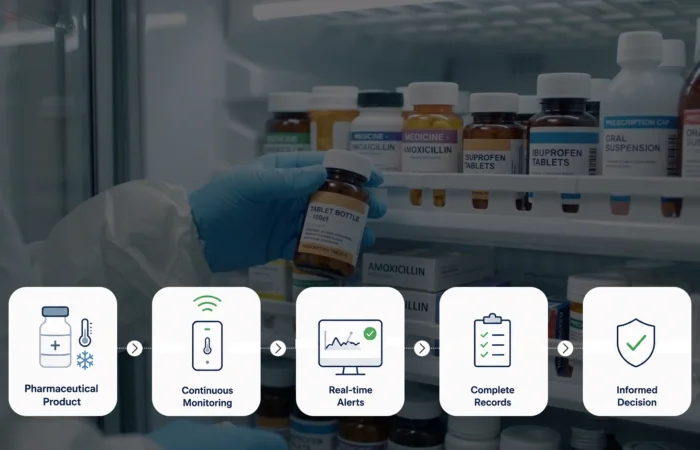
If a medical refrigerator is used for vaccine or medicine storage, PQ may check whether it maintains the required storage temperature during normal use. This is why healthcare temperature monitoring plays a critical role during PQ — ensuring that storage conditions remain consistent and compliant throughout the qualification process.
This is why healthcare temperature monitoring plays a critical role during PQ — ensuring that storage conditions remain consistent and compliant throughout the qualification process.
IQ OQ PQ Examples in Pharmaceutical Equipment
IQ, OQ, and PQ activities depend on the equipment, its intended use, and the possible impact on product quality. The following examples show how qualification may be performed for common pharmaceutical and healthcare equipment.
| Equipment | IQ example | OQ example | PQ example |
|---|
| Stability chamber | Verify installation, utilities, documentation and calibration | Test temperature, humidity, alarms and controls | Confirm stable conditions during loaded operation |
| Autoclave | Verify installation and utility connections | Test cycles, temperature, pressure, alarms and interlocks | Confirm repeatable sterilization performance |
| Medical refrigerator | Check location, power supply, sensors and calibration | Test temperature controls, door alarms and alert functions | Confirm temperature stability during normal storage |
| HVAC system | Verify equipment, filters, ducts and utility connections | Test airflow, pressure, alarms and control functions | Confirm environmental performance during routine facility operation |
| Temperature monitoring system | Verify sensors, gateways, software and device locations | Test readings, alarm limits, notifications and data recording | Confirm consistent monitoring during normal use |
What Is Included in an IQ OQ PQ Validation Service?
A professional IQ OQ PQ validation service includes more than basic paperwork. It covers planning, protocol preparation, execution, review, documentation, and final reporting.
At Plumsense, our IQ OQ PQ validation service can include support for the following activities:
| Service Activity | What It Includes |
|---|
| Validation Planning | Understanding equipment use, process needs, and compliance requirements |
| Document Review | Reviewing URS, manuals, SOPs, calibration records, and technical documents |
| IQ Protocol Preparation | Creating an installation qualification checklist and acceptance criteria |
| OQ Protocol Preparation | Creating operational tests, alarm checks, control checks, and safety checks |
| PQ Protocol Preparation | Creating performance tests under actual working conditions |
| On-Site Execution | Performing or supporting validation tests at the facility |
| Deviation Handling | Recording and reviewing any failed or unexpected results |
| Final Report | Preparing an approved qualification report for audit records |
Validation Planning
The first step is to understand the equipment, its purpose, process requirements, and compliance needs. This helps define the correct validation approach.
Document Review
Important documents are reviewed, such as:
- User Requirement Specification
- Equipment manuals
- Design documents
- Calibration certificates
- SOPs
- Layout drawings
- Technical specifications
- Previous validation records
This helps ensure that the qualification is based on correct and complete information.
IQ Protocol Preparation
The IQ protocol defines what will be checked during installation qualification. It includes checklists, acceptance criteria, document requirements, and approval sections.
OQ Protocol Preparation
The OQ protocol defines the operational tests to be performed. It includes operating parameters, control checks, alarm checks, safety checks, and expected results.
PQ Protocol Preparation
The PQ protocol defines how the equipment will be tested during actual use. It includes test runs, process parameters, sampling plans, acceptance criteria, and reporting requirements.
On-Site Execution Support
The validation team performs or supports the execution of IQ, OQ, and PQ protocols. All observations, readings, and results are recorded properly.
Deviation Handling
If any test result does not meet the acceptance criteria, it is recorded as a deviation. The issue is reviewed, corrective action is taken, and the impact is assessed.
Final Qualification Report
After successful execution, a final report is prepared. This report summarizes the qualification activity, results, deviations, approvals, and conclusion.
Equipment That Needs IQ OQ PQ Validation
Many types of pharma and healthcare equipment may need IQ OQ PQ validation. The requirement depends on how the equipment is used and how much it can affect product quality, patient safety, or compliance.
| Equipment / System | Common Use | Why Validation Is Important |
|---|
| Autoclaves | Sterilization | Confirms proper temperature, pressure, and cycle performance |
| Stability Chambers | Product stability testing | Ensures controlled temperature and humidity conditions |
| HVAC Systems | Cleanroom and facility control | Supports air quality, pressure, and environmental control |
| Cleanrooms | Controlled manufacturing areas | Helps maintain contamination control |
| Medical Refrigerators | Vaccine and medicine storage | Confirms stable storage temperature |
| Cold Rooms | Pharma and healthcare storage | Supports temperature-controlled storage |
| Laboratory Instruments | Testing and analysis | Helps ensure accurate and reliable results |
| Filling Machines | Pharma production | Supports consistent filling volume and product quality |
| Water Systems | Pharma utilities | Helps maintain water quality for production use |
| Temperature Monitoring Systems | Storage and monitoring | Confirms accurate temperature tracking and alerts |
Other equipment that may need IQ OQ PQ validation includes:
- Freezers
- Environmental monitoring systems
- Sterilization equipment
- Medical device manufacturing equipment
- Healthcare storage systems
- Tablet compression machines
- Coating machines
- Blister packing machines
- Mixers and granulators
- Compressed air systems
Any equipment that directly or indirectly affects product quality, healthcare storage, or patient safety should be reviewed for qualification requirements.
IQ OQ PQ Documentation Required for GMP Compliance
Documentation is one of the most important parts of IQ OQ PQ validation. In pharma and healthcare, proper documentation helps prove that every activity was performed correctly.
A complete IQ OQ PQ documentation package may include:
| Document | Purpose |
|---|
| Validation Plan | Defines the validation approach and scope |
| User Requirement Specification | Explains what the user expects from the equipment |
| Risk Assessment | Identifies possible quality and compliance risks |
| IQ Protocol | Defines installation checks |
| OQ Protocol | Defines operational checks |
| PQ Protocol | Defines performance checks |
| Test Data Sheets | Records actual test results |
| Calibration Certificates | Confirms instruments are calibrated |
| SOP References | Links validation with approved procedures |
| Deviation Reports | Records and reviews unexpected results |
| Change Control Records | Tracks changes that may affect validation |
| Final Qualification Report | Summarizes results and final approval |
| Traceability Matrix | Links requirements with qualification tests |
IQ OQ PQ Protocol Checklist
A qualification protocol should clearly define what will be tested, how the tests will be performed, and what results are required for approval.
A typical IQ OQ PQ protocol should include:
- Equipment name, model, and identification number
- Qualification purpose and scope
- Roles and responsibilities
- User Requirement Specification references
- Required test instruments
- Calibration status
- Test procedures
- Predefined acceptance criteria
- Actual test results
- Supporting data and attachments
- Deviations and corrective actions
- Traceability to user requirements
- Conclusion
- Review and approval signatures
Acceptance criteria should be approved before testing begins. Any result that does not meet the criteria should be documented, investigated, and resolved before final qualification approval.
FDA guidance states that qualification planning should identify the tests, acceptance criteria, timing, responsibilities, and documentation procedures, followed by an approved report and conclusion.
When Should IQ OQ PQ Validation Be Performed?
IQ OQ PQ validation is usually performed in these situations:
- When new equipment is installed
- When equipment is relocated
- When major parts are changed
- When software or control systems are updated
- When there is a major repair
- When the process or product changes
- During requalification
- Before regulatory audits
- When compliance requirements demand it
For pharma and healthcare companies, requalification frequency should be based on risk, equipment criticality, usage, and internal quality procedures.
Common Mistakes in IQ OQ PQ Validation
Many companies face audit issues because of weak or incomplete validation documents. Some common mistakes include:
- Using generic protocols
- Missing acceptance criteria
- Incomplete test data
- Missing calibration certificates
- Poor deviation handling
- No final report conclusion
- Missing approval signatures
- Not linking URS with qualification tests
- Performing PQ before proper IQ and OQ
- Not updating documents after equipment changes
These mistakes can create compliance risk. Working with an experienced validation service provider like Plumsense helps avoid these problems.
How Plumsense Helps with IQ OQ PQ Validation Service
Plumsense supports pharma, healthcare, biotechnology, and medical device companies with practical IQ OQ PQ validation services.
Our goal is to help companies qualify equipment properly, maintain audit-ready documentation, and meet GMP compliance expectations.
Plumsense can help with:
- IQ OQ PQ protocol preparation
- Equipment qualification documentation
- GMP validation support
- Healthcare equipment validation
- Pharma equipment validation
- Medical device equipment qualification
- On-site validation execution
- Deviation documentation
- Final qualification reports
- Requalification support
- Audit-ready documentation
Plumsense focuses on making the validation process clear, organized, and compliant without making it unnecessarily complex.
Plumsense focuses on making the validation process clear, organized, and compliant without making it unnecessarily complex.
How to Choose the Right IQ OQ PQ Validation Service Provider
Choosing the right validation partner is important. A good provider should understand pharma equipment, healthcare equipment, GMP requirements, and documentation needs.
Before selecting a provider, check whether they can:
- Prepare clear and equipment-specific protocols
- Understand GMP compliance requirements
- Support on-site execution
- Handle deviations properly
- Prepare audit-ready reports
- Work with pharma and healthcare equipment
- Provide practical guidance
- Follow proper documentation practices
A good validation partner should not only complete paperwork. They should help reduce compliance risk and improve equipment reliability.
Conclusion:
IQ OQ PQ validation is an important part of pharma and healthcare equipment qualification. It helps prove that equipment is installed correctly, operates as expected, and performs consistently during real use.
For pharma, healthcare, biotech, and medical device companies, proper IQ, OQ, and PQ documentation supports GMP compliance, audit readiness, product quality, and patient safety.
If your company is installing new equipment, upgrading systems, preparing for an audit, or improving compliance documentation, working with an experienced IQ OQ PQ validation service provider can save time and reduce risk.
Plumsense helps companies with reliable IQ, OQ, and PQ validation services, protocol preparation, execution support, healthcare equipment validation, and audit-ready documentation.



 Meet
us
at NACAS C3X 2026 · Booth 120 · Chicago · Sep 27–30, 2026
Meet
us
at NACAS C3X 2026 · Booth 120 · Chicago · Sep 27–30, 2026
 See continuous monitoring live at Booth 120 · Book a 15-minute demo
 Visit
us at www.plumsense.com
Visit
us at www.plumsense.com