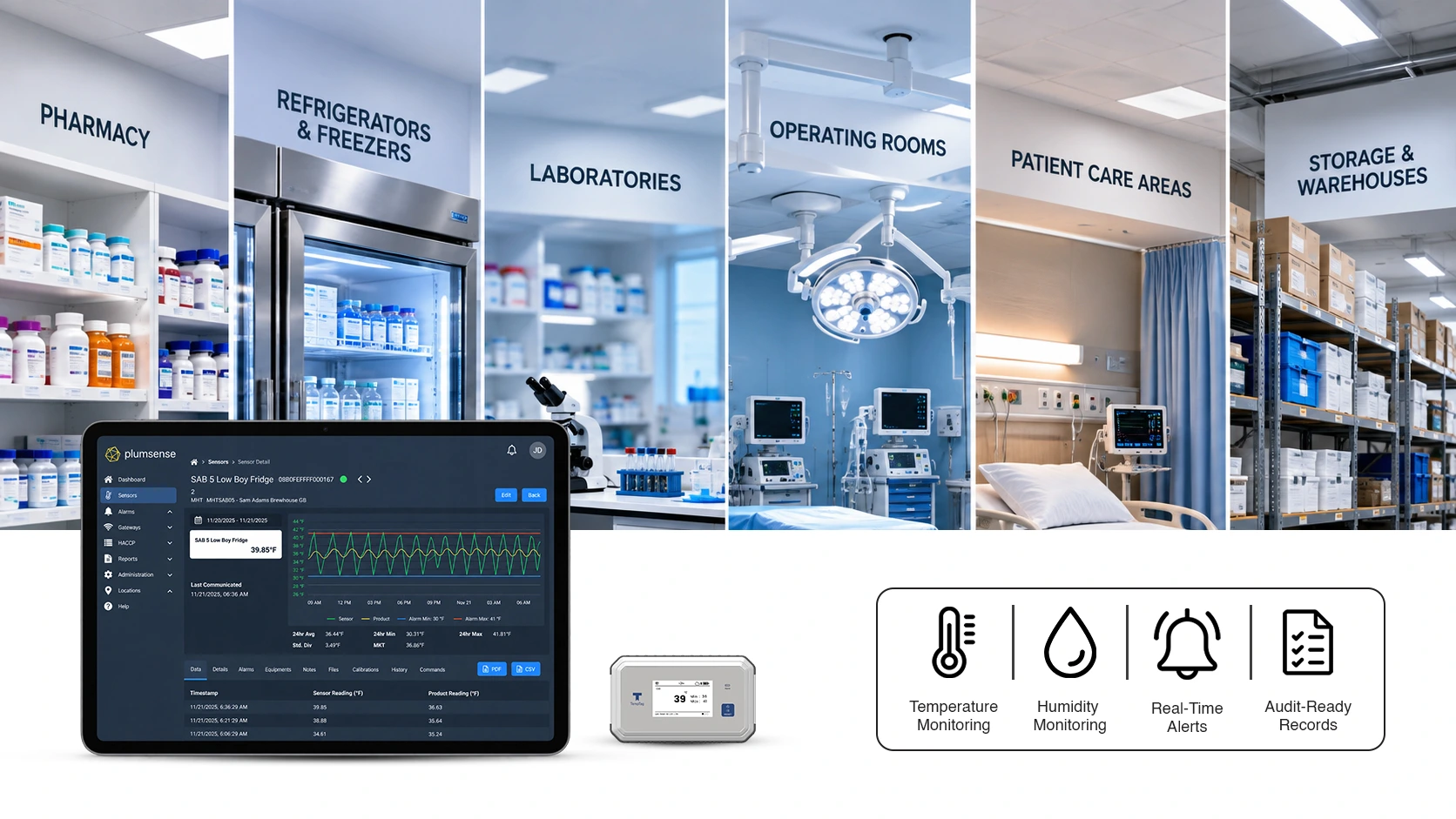
Meet Plumsense at IAAPA Expo 2026 · Booth W2282 · Orlando, FL · Nov 17–20, 2026
 Visit us at www.plumsense.com


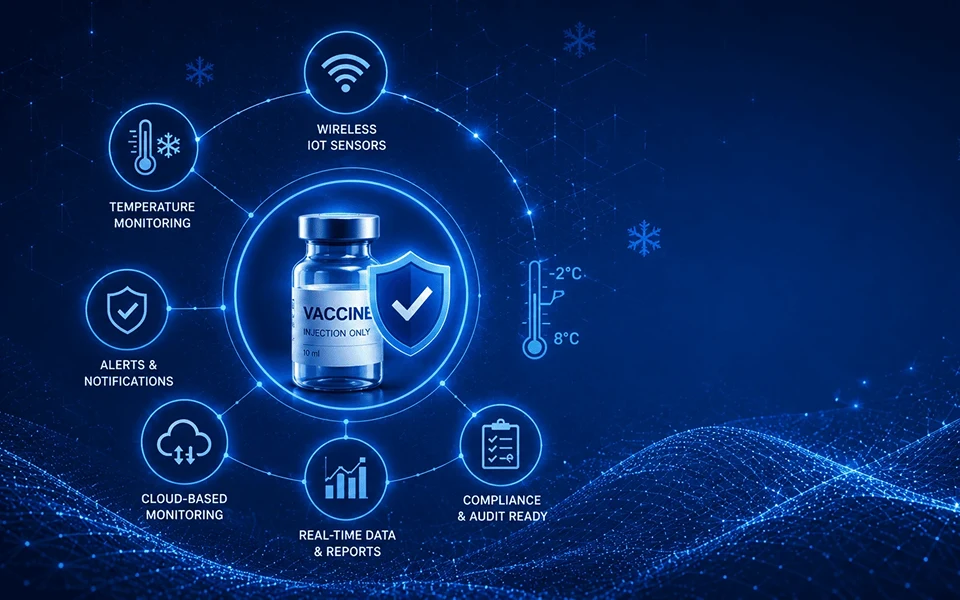
Vaccine potency is fragile. A single hour at the wrong temperature can destroy millions of doses. A four-hour exposure to room temperature can reduce vaccine efficacy by 30–50%, depending on the vaccine type. Patients get vaccinated with a compromised product. They think they’re protected. They’re not.
The US spends $500 million annually replacing vaccine doses lost to temperature deviation. That’s not accounting for the downstream cost: unprotected patients, disease outbreaks, and liability. One hospital’s cold chain failure can compromise community immunity rates.
The CDC’s Vaccine Storage and Handling Guidance is mandatory for every provider. But guidance is not the same as execution. Most healthcare facilities still rely on manual temperature checks or outdated systems. Manual checks fail. Continuous monitoring doesn’t.
CDC Vaccine Cold Storage Requirements
The CDC requires all vaccine storage areas to maintain specific temperature ranges:
General Requirements:
- Dedicated vaccine refrigerators only (no food storage, no household units)
- Temperature monitoring 24/7 – 365 with continuous logging
- Thermometers that are certified (calibrated annually, ISO 17025 standard, ±1°C accuracy or better)
- Backup power systems (generator or battery backup for a minimum of 4 hours)
- Alarm systems that notify staff within 30 minutes of any deviation
- Written protocol for handling temperature excursions
- Staff training on proper handling and response procedures
- Records retained for 3 years minimum (CDC inspection standard)
The CDC’s Pink Book (Epidemiology and Prevention of Vaccine-Preventable Diseases) contains the definitive reference for storage and handling. This is the standard auditors use. If you can’t cite it, you’re out of compliance.
Temperature deviations of even 1°C above or below the recommended range can reduce vaccine potency. The longer the deviation, the greater the damage. There’s no safe threshold; every minute outside the proper range counts.
Vaccine Temperature Sensitivity by Type
| Vaccine Type | Storage Temp | Sensitivity | Potency Loss (4h deviation) | Potency Loss (24h deviation) | Stability Window |
|---|---|---|---|---|---|
| mRNA (Pfizer, Moderna) | -80 to -60°C | Extreme | 40–60% | 80%+ (total loss) | Hours |
| Live attenuated (MMR, varicella) | 2–8°C | High | 30–50% | 70–90% | Days–weeks |
| Inactivated (flu, polio) | 2–8°C | High | 20–40% | 60–80% | Weeks–months |
| Hepatitis A/B | 2–8°C | Medium | 10–30% | 40–60% | Months |
| Pneumococcal (PCV, PPSV) | 2–8°C | Medium | 15–35% | 50–70% | Months |
| Rotavirus | 2–8°C | Very high | 35–55% | 75%+ | Days |
| Meningococcal | 2–8°C | Medium | 15–30% | 45–65% | Months |
| Yellow fever | 2–8°C | High | 25–45% | 65–85% | Weeks |
Key insight: mRNA vaccines are the most fragile. A 4-hour excursion to 0°C (freezing) permanently damages them. A 4-hour excursion to 20°C (room temp) reduces potency 40–60%. There’s no recovery. The product is compromised or lost.
Live attenuated vaccines are nearly as sensitive. They degrade faster than inactivated vaccines but not as fast as mRNA.
If a provider can’t prove the cold chain was maintained, CDC guidance says to treat the vaccine as potentially compromised and use it only if:
- The deviation was documented and brief (<30 min for most)
- Stability data from the manufacturer allows it
- The provider consults the manufacturer or state health authority
Most of the time, the answer is: discard it.
Real-World Vaccine Cold Chain Failures
Case 1: The Clinic Refrigerator Failure
A primary care clinic in Colorado noticed its vaccine refrigerator wasn’t cooling properly on a Friday afternoon. Staff couldn’t reach their supplier until Monday. Over the weekend, the temperature drifted from 5°C to 18°C. Monday morning, they discovered 2,000 doses stored at room temperature for 60+ hours. Loss: $12,000 in vaccine stock + 2-week clinic shutdown for immunisations while stock was replaced. The clinic also had to notify 300 patients who’d been vaccinated the week prior, uncertain of their protection.
Case 2: The Shipping Container Failure
A regional health department distributed vaccines to rural clinics via courier. The delivery container (passive cooler with ice packs) was left on a loading dock in direct sunlight for 3 hours. The temperature inside reached 22°C. The data logger showed the excursion, but the clinics didn’t know about it until 10 days later, when the health department reviewed the data. By then, doses had been administered. An estimated 400–500 doses are compromised. Result: the health department had to track patients and discuss revaccination; clinics faced liability questions.
Case 3: The Staff Error
A hospital pharmacy moved vaccines to a new cold room. A staff member set the thermostat to “defrost” instead of normal operation—intending to clean the old unit. The new unit ran in defrost cycle for 8 hours (regular freezing off, temp rose to 15°C). No one checked until the next morning. 1,500 doses at risk. The hospital had to quarantine, conduct stability testing, and ultimately discard the entire batch. Cost: $22,500 + staff retraining + incident report.
All three of these failures would have been caught within minutes by continuous monitoring with alerts.
Get CDC-Audit-Ready Vaccine Monitoring
Why Manual Checks Fail
Manual temperature monitoring (the old way):
- Requires staff to physically check the thermometer twice daily (minimum)
- Creates gaps of 12+ hours with zero visibility
- Depends on staff consistency (someone’s on vacation, someone forgets)
- Records are paper-based (easily lost, hard to audit)
- No way to catch short excursions that happen overnight
- Takes 15–20 minutes per check (staff time cost adds up)
Result: CDC audits find that 30–40% of vaccine storage providers with manual-only monitoring have undetected temperature excursions at least once per year.
One undetected excursion can compromise 100–1,000 doses without anyone knowing. Patients get vaccinated with a potentially ineffective vaccine. They have no protection. They don’t know. The clinic doesn’t know. By the time anyone figures it out, it’s often too late.
CDC guidance explicitly recommends continuous automated monitoring over manual checks, precisely because manual fails so often.
CDC Vaccine Storage Inspection Checklist
When a state health department or they look for:
| Requirement | What Auditors Verify |
|---|---|
| Temperature monitoring | Continuous logging system, data visible in real-time, 24/7 coverage |
| Thermometer calibration | Annual cert from ISO 17025 lab, ±1°C accuracy verified |
| Alarm system | Tests conducted, response protocol proven, staff training documented |
| Backup power | Generator/battery tested, capacity verified for a minimum of 4 hours |
| Deviation protocol | Written procedure, staff signatures showing they’ve read it, test incident documented |
| Storage conditions | Proper refrigerator/freezer (not household), no food storage, adequate space for air circulation |
| Organisation | Vaccines organised by expiration date, no crowding, proper shelving |
| Staff training | Documentation showing all staff trained on storage, handling, and deviation response |
| Records | 3 years of temperature logs (automated system preferred, paper acceptable if complete) |
If any of these are missing or weak, the provider gets a deficiency citation. Two deficiencies = corrective action plan required. Three or more = potential loss of funding or authorisation to administer vaccines.
Monitoring Technology Comparison
| System Type | Cost | Accuracy | Audit Trail | Real-Time Alert | Compliance |
|---|---|---|---|---|---|
| Manual thermometer | $20–50 | ±2–3°C | Paper logs (unreliable) | None | Fails CDC audit |
| Basic data logger | $100–300 | ±1°C | Downloaded via USB (gaps) | No | Partial, requires manual checks |
| Wi-Fi continuous monitor | $400–800 | ±0.5°C | Cloud-based, auto-export | Email/SMS alerts | Full CDC compliance |
| Gold standard: IoT + API | $800–1,500 | ±0.1°C | Immutable cloud record | Instant SMS/email + escalation | Exceeds CDC requirements |
For vaccine storage, the difference between a manual-only system and continuous monitoring is the difference between hoping nothing goes wrong and knowing everything is fine.
How to Implement Vaccine Cold Chain Monitoring
Step 1: Assess Current System
- Document all vaccine storage locations (fridges, freezers, transport containers)
- Note current monitoring method (manual check, old data logger, nothing)
- Review the last state health department inspection, cold chain findings from the CDC
- Identify who’s responsible for temperature checks (single point of failure?)
Step 2: Choose Your System
- Look for systems with CDC-recognised automated monitoring.
- Verify thermometer sensors are ISO 17025 calibrated (documentation provided)
- Confirm the system can export reports in formats that state health departments accept (usually CSV/PDF)
- Test alert capability: can you receive SMS alerts at 3 AM and respond?
- Ensure system logs are continuously (no data gaps)
Step 3: Install & Validate
- Place temperature sensors in the coldest and warmest spots in each unit
- Set alarm thresholds: 2–8°C for most vaccines (some mRNA require -80 to -60°C)
- Run parallel monitoring for 30 days: new system + manual thermometer (validate accuracy)
- Have thermometer calibrated against certified reference standard per ISO 17025 (calibration certificate required for audits)
- Test backup power: ensure the system continues logging if the power cuts out
Step 4: Configure Alerts
- Set deviation alert threshold: immediately (not “at the end of the day”)
- Alert recipients: pharmacy manager + backup staff + facility director
- Response protocol: written procedure, per CDC guidance, posted, staff trained
- Test alert system: simulate a temperature deviation, confirm alerts are received
- Document alert test in writing (auditors will ask for proof it works)
Step 5: Train All Staff
- Everyone who touches vaccines needs to understand the cold chain
- Training must cover: proper storage, handling, deviation response per CDC, and documentation
- Documented training: sign-off sheet, dates, what was covered
- Quarterly refresher training (staff turnover, memory fade)
- New hire training before they handle any vaccine
Step 6: Establish Deviation Response Protocol
- Alert received → immediate action (don’t wait)
- Isolate affected vaccines (mark, don’t use)
- Document: time of deviation, duration, temperature range, cause (if known)
- Contact the vaccine supplier/health department within 24 hours, per the CDC
- Decide: salvage or discard (supplier usually makes final call)
- File incident report: dates, actions taken, outcome
- Follow-up: Why did this happen? How do we prevent it next time?
Step 7: Audit & Compliance
- Monthly: review temperature logs for any excursions (automated system makes this easy)
- Quarterly: thermometer accuracy check (compare to ISO 17025 calibrated reference)
- Annually: full system validation + backup power test
- Prepare for inspection: have all documentation organised per CDC requirements (logs, certs, training records, incident reports)
- Share data with the state health department upon request (required for federal programs like VFC/VIIS)
Cost vs. Impact
| Item | Cost |
|---|---|
| Continuous monitoring system | $800–$1,500 (one-time) |
| Monthly monitoring service | $50–$150 |
| Annual thermometer calibration ISO 17025 | $100–$200 |
| Annual total | $1,400–$3,300 |
| Loss from one vaccine batch due to cold chain failure | $5,000–$50,000+ |
| State health department citation + corrective action | $5,000–$25,000 (remediation) |
| Liability if patient harm occurs from a compromised vaccine | $50,000–$500,000+ |
One cold chain failure pays for 10+ years of monitoring. Most providers break even within months.
Key Stats
- CDC estimates 30–40% of vaccine storage providers have undetected temperature excursions annually
- $500M+ in vaccine doses are lost annually in the US due to cold chain failures
- mRNA vaccine compromised by 4-hour room temperature exposure: 40–60% potency loss
- Continuous monitoring reduces vaccine storage losses by 80–95%
- State health department audits cite cold chain issues in 25% of inspections
- Practices with automated monitoring pass audits 99% of the time; manual-only pass 60% of the time