Meet Plumsense at IAAPA Expo 2026 · Booth W2282 · Orlando, FL · Nov 17–20, 2026
 Visit us at www.plumsense.com


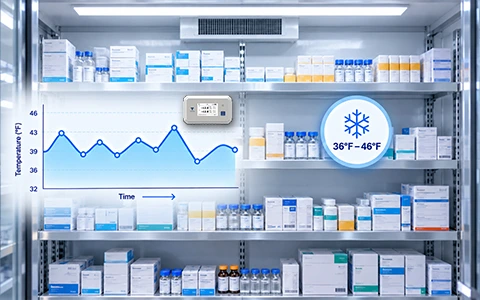
A pharmaceutical warehouse records a temperature of 72°F in the morning, 79°F in the afternoon, and 73°F at night. The average temperature may appear acceptable, but does that mean the stored medicines were unaffected by the warmer conditions?
Not necessarily. The average alone may not tell the whole story.
Temperature fluctuations can affect the quality and stability of pharmaceutical products. The extent of their impact depends on how high the temperature rises, how long the exposure lasts, and the product’s stability characteristics.
This raises an important question: How can we assess the effect of changing temperatures rather than simply looking at the average?
One useful tool is Mean Kinetic Temperature (MKT). It helps quality teams look beyond a simple average and better understand the thermal conditions a product has experienced during storage or transportation.
What Is Mean Kinetic Temperature (MKT)?
Mean Kinetic Temperature is a calculated temperature that represents the combined effect of fluctuating temperatures on a product’s chemical degradation over time.
In simple terms, MKT helps estimate the overall thermal stress a product has experienced based on its recorded temperature history.
Consider two medicines stored under different conditions. One remains at a steady 77°F, while the other experiences temperatures ranging between 68°F and 86°F. Even if both have the same average temperature, their exposure to heat may have different implications for product stability.
Why does this happen? Many chemical reactions that affect product stability accelerate as temperatures rise. This means that periods of higher temperatures can have a greater influence on degradation than a simple arithmetic average would suggest.
MKT takes this temperature-dependent effect into account, making it a useful tool for evaluating pharmaceutical storage and transportation conditions.
Why Is MKT Important in Pharmaceutical Storage?
Pharmaceutical products often have specific temperature requirements to maintain their quality, stability, and effectiveness throughout their shelf life.
However, maintaining consistent temperatures is not always easy. During storage or transportation, temperatures may fluctuate due to equipment operation, power interruptions, loading activities, or changes in surrounding environmental conditions.
Even a temporary temperature deviation may raise concerns about product quality. But how can quality teams determine whether the recorded fluctuations require further investigation?
This is where MKT can help.
A temperature excursion occurs when the temperature moves outside the specified acceptable range. MKT can help quality teams assess the combined effect of temperature variations over a selected period and provide additional context when reviewing such events.
MKT may support:
- Reviewing temperature history during storage and transportation.
- Investigating certain temperature excursions.
- Understanding the potential impact of exposure to warmer conditions.
- Supporting documented product-quality assessments.
However, MKT is only one part of the overall assessment. It cannot, by itself, confirm that a pharmaceutical product remains safe, stable, or suitable for use. A thorough evaluation must also consider the product’s specific storage requirements, stability data, duration of exposure, and applicable quality guidelines.
Ultimately, understanding temperature data is not just about knowing how warm a product became. It is about evaluating what those temperature changes could mean for product quality.
MKT vs. Average Temperature: What’s the Difference?
Average temperature tells you the arithmetic mean of the recorded temperatures over a given period. However, it does not account for the fact that higher temperatures can have a greater effect on chemical degradation.
Mean Kinetic Temperature (MKT) goes a step further. It considers the temperature-dependent nature of chemical reactions, helping quality teams better understand the potential thermal stress experienced by a pharmaceutical product.
Let’s consider a simple example.
Two storage areas have the same average temperature of 77°F, but their temperature patterns differ.
Storage Area A: The temperature remains close to 77°F throughout the day.
Storage Area B: The temperature rises to 86°F for part of the day and falls to 68°F for another part.
Although both areas have the same arithmetic average, Storage Area B may have a higher MKT because higher-temperature exposure has a greater influence on the calculation. The exact result depends on the temperature readings, the time spent at each temperature, and the activation energy used.
This illustrates an important point: the same average temperature does not necessarily mean the same thermal impact. Average temperature is useful for understanding general conditions, while MKT provides another perspective on the potential effect of temperature fluctuations.
| Average Temperature | Mean Kinetic Temperature (MKT) |
| Shows the arithmetic average of recorded temperatures | Estimates the combined thermal effect of temperature variations using a kinetic model |
| Gives equal weight to each reading | Reflects the greater influence of higher temperatures on temperature-dependent reactions |
| Useful for general temperature reviews | Useful for certain pharmaceutical stability and temperature-excursion assessments |
Both values are useful, but they answer different questions. Average temperature tells us what the typical temperature was, while MKT helps assess the potential impact of the temperature history on product stability.
How Is Mean Kinetic Temperature Calculated?
Understanding the concept of MKT is one thing; calculating it is another. The calculation uses recorded temperature readings and a formula based on how temperature influences chemical reaction rates.
Unlike a simple arithmetic average, MKT uses an exponential relationship to account for the greater effect of higher temperatures. This makes the calculation particularly relevant when reviewing temperature data for pharmaceutical storage and transportation.
The calculation considers:
- Recorded temperatures: The temperature readings collected during the selected period.
- Exposure duration: How long the product remains at each temperature. For equally spaced readings, each reading represents an equal time interval.
- Activation energy: A value that describes how strongly a chemical reaction responds to changes in temperature.
For equally spaced readings, the standard MKT calculation can be expressed as:
[
T_{\mathrm{MKT}}=
\frac{-\Delta H/R}
{\ln\left(\frac{1}{n}\sum_{i=1}^{n}
e^{-\Delta H/(RT_i)}\right)}
]
Where:
- (T_{\mathrm{MKT}}) = Mean Kinetic Temperature in Kelvin.
- (T_i) = Each recorded temperature in Kelvin.
- (n) = Number of temperature readings.
- (R) = Universal gas constant.
- (\Delta H) = Activation energy.
Note that the formula works in Kelvin, so Fahrenheit readings must be converted to absolute temperature before the calculation. Reporting the result back in Fahrenheit is a straightforward conversion.
For routine temperature analysis, an appropriate calculation tool can process the recorded readings and apply the selected assumptions. However, the reliability of the result depends on the quality of the temperature data, the sampling intervals, and the suitability of the activation-energy value.
Understanding these factors helps ensure that MKT results are interpreted correctly and used appropriately in pharmaceutical quality assessments.
A Simple MKT Example
Let’s see how MKT works with a practical example.
Suppose a pharmaceutical storage area records the following temperatures at equal time intervals:
68°F, 72°F, 76°F, 82°F, 78°F, and 74°F
The arithmetic average of these readings is 75.0°F.
Using a commonly applied activation-energy assumption of 83.144 kJ/mol, the calculated MKT is approximately 75.6°F.
Notice the difference? Although the average temperature is 75.0°F, the MKT is slightly higher because the calculation gives greater weight to the effect of warmer temperatures.
This example highlights why MKT can provide additional insight into temperature variations that a simple average may not fully capture.
However, a calculated MKT value does not, by itself, determine whether storage conditions were acceptable for a particular medicine. That decision requires consideration of the product’s approved storage requirements, stability data, and any applicable quality guidelines.
How Can You Apply MKT in Temperature Analysis?
Understanding MKT is useful, but its real value lies in how it is applied to temperature monitoring and quality assessments.
A systematic review process helps ensure that temperature data is collected, analyzed, and interpreted appropriately. Here are five practical steps to follow.
1. Collect Temperature Records
Start by gathering temperature data from the relevant storage area or shipment.
These records may come from data loggers, temperature mapping studies, or continuous temperature monitoring systems.
Ensure that the records cover the relevant assessment period, contain reliable readings, and come from properly maintained monitoring equipment. Complete and accurate data is essential for meaningful analysis.
2. Check for Temperature Excursions
Next, review the records to identify any readings that fall outside the product’s specified storage range.
For example, if a product must be stored between 68°F and 77°F, a recorded temperature of 84°F would require investigation.
Look beyond the peak reading. Record how high the temperature reached, how long the excursion lasted, and when it occurred. These details can help the quality team assess the potential impact on the product.
3. Calculate MKT
Once the temperature records have been reviewed, use an appropriate calculation method to determine the MKT for the selected period.
Ensure that the calculation method, time intervals, and assumptions are suitable for the data being analyzed. For routine assessments, validated tools or appropriate calculation software can help simplify the process and reduce manual errors.
4. Review the Result Carefully
The calculated MKT provides additional information about thermal exposure, but it should always be interpreted alongside the product’s stability data and storage requirements.
For instance, a product exposed to a very high temperature for a short period could still have an MKT that appears acceptable. This does not automatically mean the product is suitable for use.
The magnitude and duration of the excursion, the product’s stability characteristics, and the applicable quality procedures must also be considered. Where necessary, the quality team should seek a product-specific assessment before making a decision.
5. Document the Findings
Finally, maintain a clear record of the temperature history, excursion details, MKT calculations, investigation findings, and any corrective or preventive actions taken.
Good documentation supports traceability, facilitates quality reviews, and helps teams identify recurring storage or transportation issues.
Over time, these records can also help organizations recognize temperature trends and identify opportunities to improve monitoring practices, equipment performance, and temperature-control processes.
Can MKT Be Used for Every Temperature Excursion?
No. Although Mean Kinetic Temperature (MKT) is useful in certain pharmaceutical quality assessments, it is not suitable for every product or every type of temperature excursion.
MKT is primarily used to evaluate temperature exposure where chemical degradation is relevant. However, not all temperature-related damage follows the same pattern.
For example, freezing can damage certain vaccines and biological products through mechanisms that MKT may not adequately capture. Similarly, a calculated MKT cannot override a product’s specified storage limits or establish its suitability for use.
The United States Pharmacopeia (USP) discusses MKT in the context of temperature-excursion assessment in General Chapter <1079.2>.
Therefore, before using MKT to support a product-quality decision, organizations should consider applicable guidance, product-specific stability information, the nature and duration of the excursion, and their approved quality procedures.
How Continuous Temperature Monitoring Supports MKT Analysis
Accurate MKT calculations begin with reliable temperature data. Without a sufficiently representative temperature history, important fluctuations may go unnoticed, potentially affecting the assessment.
When temperatures are checked manually only a few times a day, changes occurring between inspections may be missed. Continuous temperature monitoring helps address this gap by providing a more detailed record of storage conditions over time.
Consider a pharmaceutical warehouse where the morning temperature reading falls within the acceptable range. A cooling system malfunction later in the day could cause temperatures to rise for several hours before the next manual inspection.
With continuous monitoring, the temperature rise can be recorded, helping staff identify when the excursion began, how high the temperature reached, and how long it lasted. This information can support an investigation and, where appropriate, subsequent MKT analysis.
This is where reliable monitoring and meaningful temperature analysis work together.
Plumsense provides temperature monitoring solutions for pharmaceutical storage, healthcare facilities, laboratories, and other temperature-sensitive environments.
Through wireless sensors, temperature alerts, and historical records available on a centralized platform, Plumsense helps teams monitor environmental conditions and review temperature changes across their storage areas.
When MKT is appropriate for the products being assessed, these records can provide useful input for the calculation and help quality teams investigate temperature excursions more effectively.
Conclusion
Mean Kinetic Temperature helps pharmaceutical quality teams understand the combined effect of changing temperatures during storage and transportation. By accounting for the greater influence of higher temperatures on temperature-dependent chemical reactions, MKT provides information that a simple arithmetic average may not fully capture.
However, MKT is only one part of a comprehensive temperature assessment. Product-specific storage requirements, stability information, and the circumstances surrounding any temperature excursion must also be considered.
Reliable temperature monitoring is the starting point for meaningful temperature analysis. Accurate records help teams identify fluctuations, investigate potential risks, and make better-informed quality decisions.
Explore Plumsense to learn how real-time temperature monitoring and historical records can support your pharmaceutical storage operations.